

Survival through Quality
PRODUCT CENTER
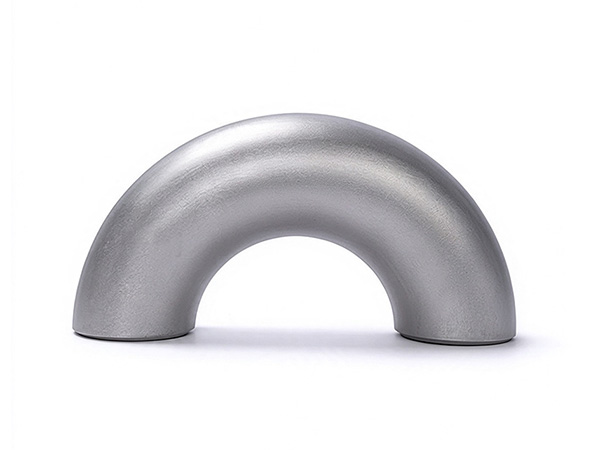
180 degree elbow
What is a 180 Degree Elbow?
A 180 degree elbow, also known as a return bend or U-bend, is a butt-welded fitting that redirects flow by 180 degrees in a piping system. It forms a smooth U-shaped return that allows two parallel pipe runs to be connected in a compact space. 180 degree elbows are widely used in heat exchanger coils, boiler tubes, condenser circuits, and process piping where a return loop is required without excessive pressure loss.
Standards and Specifications
180 degree elbows are manufactured to ASME B16.9 for factory-made butt-welding fittings and ASME B16.28 for short-radius returns. They also conform to MSS SP-75, ASTM A234, and EN 10253. Sizes range from NPS 1/2 to NPS 48 (DN15 to DN1200), with wall schedules from SCH 10 to SCH XXS. Long-radius (R=1.5D) and short-radius (R=1.0D) patterns are available depending on space and flow requirements.
Materials and Grades
Carbon steel A234 WPB is standard for general service. Stainless steel 304/304L and 316/316L provide corrosion resistance for chemical, food, and marine applications. Alloy steel WP11, WP22, and WP91 grades handle high-temperature power and refinery service. Low-temperature grade A420 WPL6 is available for cryogenic piping. All material is traceable by heat number.
Pressure and Temperature Ratings
180 degree elbows are rated for pressure classes matching the pipe system, from Class 150 to Class 2500. The long-radius sweep minimizes flow turbulence and erosion at the bend. Temperature range depends on material: carbon steel to 425 degrees Celsius, alloy steel to 600 degrees Celsius, stainless steel from cryogenic to 800 degrees Celsius. Each elbow is hydrostatically tested.
Applications
180 degree elbows are used in shell-and-tube heat exchangers, boiler tube returns, condenser circuits, refrigeration loops, process piping, and coil distribution systems. They connect two parallel pipe runs where flow must reverse direction, such as in hairpin heat exchangers, tracer loops, and serpentine heating or cooling circuits.
Advantages
The smooth U-shaped return provides gradual flow direction change with low pressure drop and minimal erosion. Long-radius bends reduce turbulence and vibration compared with sharp miter bends. Butt-welded construction provides full-bore continuity and structural strength. 180 degree elbows eliminate the need for two 90-degree elbows with spool pieces, reducing weld count and installation time.
Installation Guidelines
Bevel the pipe ends, align the return bend, and tack weld in position. Complete the butt weld using GTAW root and SMAW fill passes with matching filler metal. For thick-wall or alloy material, apply preheat and post-weld heat treatment. Radiographic inspection of the welds verifies full penetration. Support the return bend properly to absorb thermal expansion and prevent vibration.
Quality Assurance
Each 180 degree elbow is marked with material grade, heat number, size, wall thickness, and manufacturer's stamp. Inspection includes dimensional checks, wall thickness verification, visual examination, and NDE when specified. Material test certificates to EN 10204 3.1 are provided. Elbows are coated with rust-preventive oil and packaged in wooden cases for export.