

Survival through Quality
PRODUCT CENTER
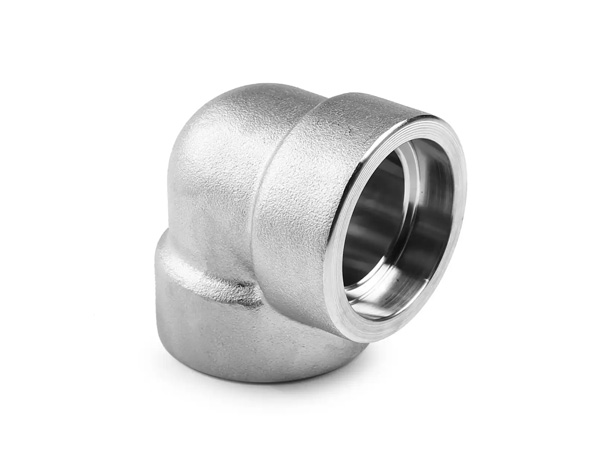
Socket weld 90° elbow
What is a Socket Weld 90 Degree Elbow?
A socket weld 90 degree elbow is a forged pipe fitting that changes flow direction by a right angle in compact piping systems. Each end has a precision-machined socket for pipe insertion, followed by a fillet weld around the joint. The 90-degree elbow is the most commonly used fitting for redirecting flow, routing equipment connections, and navigating around structural obstacles in high-pressure small-bore piping.
Standards and Specifications
Socket weld 90 degree elbows are manufactured to ASME B16.11, the standard for forged steel socket weld and threaded fittings. They also meet MSS SP-97, BS 3799, and DIN specifications. Available sizes range from 1/8 inch to 4 inches (DN6 to DN100), with pressure classes of 3000 LB, 6000 LB, and 9000 LB. Both long-radius and short-radius patterns are available depending on space and flow requirements.
Materials and Grades
Carbon steel A105, A105N, and LF2 are used for oil, gas, water, and steam service. Stainless steel 304/304L and 316/316L offer corrosion resistance for chemical, food, pharmaceutical, and marine applications. Alloy steel F11, F22, F5, and F91 grades are used in high-temperature refinery and power piping. Duplex and super duplex stainless steels serve severe corrosive environments.
Pressure and Temperature Ratings
The 3000 LB elbow is suitable for medium-pressure utility and instrument lines, while 6000 LB and 9000 LB elbows are designed for extreme pressure hydraulic and process systems. Temperature ratings vary by material grade, from cryogenic stainless steel to high-temperature alloy steel. Each fitting undergoes hydrotesting and dimensional inspection before shipment.
Applications
Socket weld 90 degree elbows are widely used in oil and gas production, refineries, petrochemical plants, chemical processing, power generation, shipbuilding, pulp and paper, and hydraulic systems. They are ideal for pump and compressor connections, instrument manifold piping, steam tracing, and cooling water loops where a compact right-angle turn is needed.
Advantages
The socket weld design provides a smooth bore, easy alignment, and strong vibration-resistant joints compared with threaded elbows. The compact forged construction saves space in tight equipment layouts. Fillet welds are visually and radiographically inspectable, and the fitting resists leakage under thermal cycling and pressure fluctuations.
Installation Guidelines
Insert the pipe fully into the socket, then withdraw about 1.6 mm (1/16 inch) to leave a gap that prevents weld stress cracking. Tack the pipe before final fillet welding. Follow recommended preheat and post-weld heat treatment for alloy and stainless materials. Use the correct filler metal and shielding gas, then clean, inspect, and pressure test.
Quality Assurance
Each elbow is marked with material grade, pressure class, size, and heat number for full traceability. Inspection includes visual examination, dimensional checks, hardness testing, and NDE when specified. Fittings are packaged in wooden cases with rust-preventive wrapping. EN 10204 3.1 material test certificates are provided.