

Survival through Quality
PRODUCT CENTER
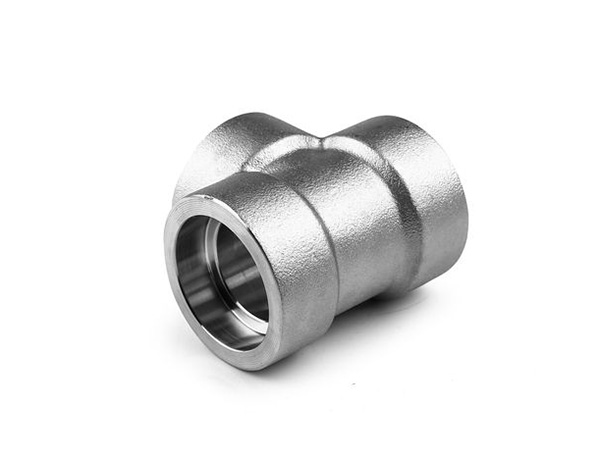
Socket weld tee
What is a Socket Weld Tee?
A socket weld tee is a forged pipe fitting with a T-shaped design that splits or combines fluid flow at a 90-degree branch connection. The main run ends have socket openings for pipe insertion, while the branch outlet also features a machined socket. Once the pipe is inserted, a fillet weld is applied around each joint. This configuration creates a strong, leak-proof connection widely used in high-pressure small-bore piping systems.
Standards and Specifications
Socket weld tees are manufactured to ASME B16.11, the standard for forged steel socket weld fittings. They also comply with MSS SP-97, BS 3799, and DIN standards. Available sizes range from 1/8 inch to 4 inches (DN6 to DN100), with pressure classes of 3000 LB, 6000 LB, and 9000 LB. Branch connections may be equal or reducing, allowing the branch line to be smaller than the main run.
Materials and Grades
Socket weld tees are supplied in carbon steel A105, A105N, and LF2 for general oil, gas, and water service. Stainless steel 304/304L and 316/316L grades provide corrosion resistance for chemical, pharmaceutical, and marine applications. Alloy steel F11, F22, F5, and F91 grades are used in high-temperature refinery and power piping. Duplex and super duplex stainless steels are available for severe corrosive environments.
Pressure and Temperature Ratings
The 3000 LB class tee is commonly used for medium-pressure instrument and utility lines, while 6000 LB and 9000 LB classes serve extreme pressure hydraulic and process systems. Carbon steel tees handle moderate temperatures, alloy steel tees withstand elevated heat, and stainless steel tees perform from cryogenic to high-temperature ranges. Each fitting undergoes hydrostatic shell testing before shipment.
Applications
Socket weld tees are widely used in oil and gas production, refineries, petrochemical plants, chemical processing, power generation, shipbuilding, and hydraulic systems. They are ideal for small-bore branch connections where a compact, robust tee is required. Typical uses include instrument air branches, steam tracing take-offs, cooling water branches, and sample connections.
Advantages
Compared with threaded tees, socket weld tees offer a smoother bore, lower turbulence, and better resistance to vibration and thermal expansion. The socket design simplifies alignment and eliminates the need for precise butt-weld end preparation. The fillet weld is visually and radiographically inspectable, and the joint resists leakage better than threaded connections under cyclic loading.
Installation Guidelines
Insert the pipe fully into the socket, then withdraw about 1.6 mm (1/16 inch) to leave a gap that prevents weld stress from cracking the root. Tack the pipe before final fillet welding. For stainless and alloy materials, apply recommended preheat and post-weld heat treatment. Use matching filler metal and shielding gas, then clean, inspect, and pressure test the completed joint.
Quality Assurance
Each socket weld tee is marked with material grade, pressure class, size, and heat number for traceability. Inspection includes visual examination, dimensional checks, hardness testing, and NDE when specified. Fittings are packed in wooden cases with rust-preventive wrapping. EN 10204 3.1 material test certificates are provided with each shipment.