

Survival through Quality
PRODUCT CENTER
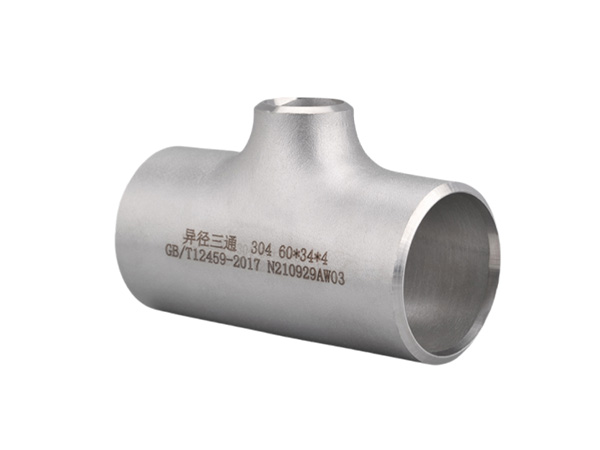
Reducing Tee
What is a Reducing Tee?
A reducing tee is a T-shaped pipe fitting with a branch outlet smaller than the main run. It splits flow from the main pipe into a smaller branch, allowing the system to branch off at a reduced size without a separate reducer. Reducing tees are widely used in process piping where a smaller take-off is needed from a larger header line.
Standards and Specifications
Reducing tees are manufactured to ASME B16.9 and ASME B16.28, conforming to MSS SP-75 and ASTM A234. The run end matches the main pipe size, while the branch end is one or two sizes smaller. Sizes range from NPS 1/2 by NPS 1/2 to NPS 48 by NPS 40, with wall schedules from SCH 10 to SCH XXS. Ends are beveled for butt welding.
Materials and Grades
Carbon steel A234 WPB is standard for general service. Stainless steel 304/304L and 316/316L provide corrosion resistance for chemical and marine applications. Alloy steel WP11, WP22, and WP91 grades handle high-temperature refinery and power service. Low-temperature A420 WPL6 is available for cryogenic piping. All material is traceable by heat number.
Pressure and Design Considerations
Reducing tees are rated for pressure classes 150 through 2500. The branch opening is reinforced by the geometry of the tee itself, with the branch wall thickness designed to handle branch loading. The transition from run to branch is engineered to minimize turbulence and stress concentration. Each tee is hydrostatically tested.
Applications
Reducing tees are used in refineries, petrochemical plants, oil and gas production, chemical processing, power generation, water treatment, and HVAC systems. They branch smaller instrument lines, sampling points, utility connections, and branch circuits from larger process headers where the branch size is smaller than the run.
Advantages
Combining the branch connection and size reduction in one fitting eliminates the need for a separate equal tee plus reducer, reducing weld count and installation space. The smooth transition minimizes pressure drop and turbulence at the branch. Fewer welds mean fewer potential leak points and lower inspection costs.
Installation Guidelines
Bevel all three ends to match the respective pipe sizes. Align the run with the header and the branch with the take-off line. Tack weld all three joints, then complete full-penetration butt welds with matching filler metal. Apply preheat and post-weld heat treatment as required. Radiographic inspection verifies weld integrity.
Quality Assurance
Each reducing tee is marked with run size, branch size, grade, heat number, wall thickness, and manufacturer's stamp. Inspection includes dimensional checks at all three ends, wall thickness verification, and NDE when specified. Material test certificates to EN 10204 3.1 are provided. Fittings are coated with rust-preventive oil and bevel ends are capped for shipping.